
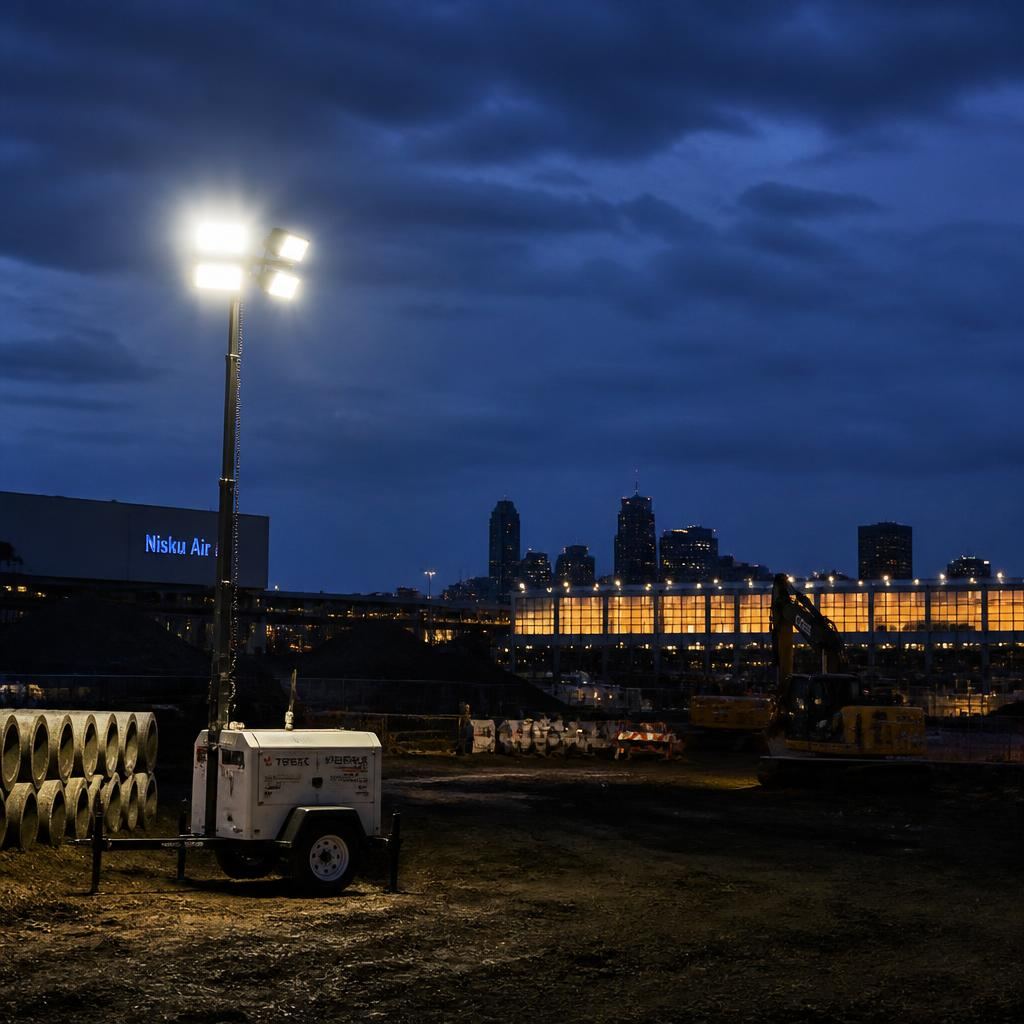
Walk into most job site trailers and you'll find a mix of work lights bought at different times from different stores, none of them quite matched to the job they're doing. That's usually not a budget problem. It's a spec problem. Most crews buy on price and brightness alone, and end up with lights that either don't hold up to an Alberta winter or don't put out enough usable light for the space they're actually working in.
Start with lumens, but don't stop there
Lumens tell you total light output, and for most general work areas, 3,000 to 5,000 lumens covers a mid-sized room or bay adequately. But raw lumen count doesn't tell you how that light is distributed. A flood-style light spreads output wide and is better for general area lighting, like lighting up a whole work bay or a section of a warehouse floor. A spot-style beam concentrates light in a narrower area and works better for detail work like wiring, inspection, or close-in fabrication.
If a crew is doing both, the answer usually isn't buying a light with a wider beam angle and hoping it works for everything. It's stocking two types and matching the light to the task.
IP rating matters more outdoors and in oilfield settings than almost any other spec
The IP (Ingress Protection) rating tells you how well a light resists dust and water. For indoor warehouse or shop use, an IP54 rating (protected against dust and light splashing) is usually enough. For outdoor use, wash-down environments, or oilfield sites where a light might get rained on, splashed with mud, or exposed to blowing dust, IP65 or higher is worth the extra cost. Buying an IP54-rated light for an outdoor yard is one of the most common reasons work lights fail early. Water gets into the housing, corrodes the internal wiring, and the light is dead within a season.
Cold weather performance isn't optional in Alberta
Not every LED work light is rated to perform in sub-zero temperatures. Cheaper units can dim significantly or fail to start in extreme cold because of how their internal drivers and battery chemistry handle low temperatures. If a light is going to sit in an unheated yard, a site trailer, or a vehicle overnight through an Alberta winter, check the manufacturer's operating temperature range before buying. A light rated to -20°C might still struggle at -35°C, which isn't a rare temperature on an Edmonton job site in January.
Battery-powered lights are especially sensitive to cold. Lithium-ion batteries lose usable capacity as temperature drops, sometimes by 30 to 40 percent in extreme cold. If your crew relies on battery lights for mobility, budget for shorter runtime in winter months or plan to keep batteries warmed in a heated cab or trailer between uses.
Corded, battery, or rechargeable: match the power source to the job
Corded lights give you unlimited runtime but tie you to an outlet or generator, which isn't always practical on a remote site or a mobile task. Battery-powered lights (often built to share a battery platform with cordless tools) are more mobile but limited by charge time and cold-weather capacity. Rechargeable lights with a built-in battery and charging dock work well for lights that stay in one general area and get topped up overnight.
A lot of crews end up standardizing on one battery platform across lights and tools specifically so batteries are interchangeable and nobody's carrying three different chargers in the truck.
Durability specs worth checking before you buy in bulk
For job site and yard use, look for an impact-rated housing (often listed with a drop rating in meters) and a durable lens material, usually polycarbonate rather than glass. Glass-lensed lights are brighter in some cases but don't survive a drop onto concrete the way a polycarbonate lens does.
A simple way to standardize your light inventory
Rather than replacing lights one at a time as they fail, most crews save money and hassle by standardizing on two or three light types across the whole operation: one flood light for general area work, one spot or task light for detail work, and one rugged, high-IP-rated light for outdoor or oilfield conditions. That way replacement parts, batteries, and chargers stay consistent, and nobody's guessing which light works for which job.
Gridwell sources LED work lights rated for Alberta's outdoor and cold-weather conditions, matched to your crew's actual work environment rather than a generic retail spec sheet.
Need it quoted?
Send us your product list, quantities, and specs. We reply to every quote request within one business day.
Request a QuoteMore from the blog
September 2026 · 5 min read
Cable Management Standards Every Contractor Should Actually Know
September 2026 · 5 min read
Cold Weather Considerations for Industrial Consumables in Alberta
September 2026 · 5 min read
Bulk Ordering vs Just-In-Time: What's Actually Cheaper for Alberta Trades and Warehouses
September 2026 · 5 min read
The Real Cost of a Bad Supplier Relationship
September 2026 · 4 min read
How to Choose the Right Cable Tie for Your Job Site (It's Not One-Size-Fits-All)
September 2026 · 4 min read
Warehouse Labeling 101: Why Barcode-Ready Rack Labels Save Your Team Real Hours
September 2026 · 4 min read
Why Local Delivery Still Beats the Big-Box Supply Run for Alberta Contractors
September 2026 · 4 min read
Tariffs and Your Supply Chain: What Alberta Trades Should Know About Sourcing in 2026
September 2026 · 4 min read
5 Signs Your Crew Is Losing Time to Poor Jobsite Organization
September 2026 · 5 min read
Plenum-Rated vs. Standard Cable Ties: What Alberta Electricians Need to Know
September 2026 · 6 min read